Richard Ford: Artist, teacher, horticulturalist

The Clunes Town Hall and Courthouse is a striking municipal building designed by Percy Oakden. Built in 1872, the distinctive building reflected the prosperity of a gold mining town in its heyday. But this is not a story about the Clunes Town Hall as such, though it is worth mentioning that the grand building has recently had a substantial makeover, returning to its original glory.

Instead the subject here is Richard Ford, arguably one of the town’s most well known and revered artists. He was born in 1875 and died in 1961 and over the course of a long life he was a council foreman, horticulturalist and park curator and later taught woodwork at the Clunes Higher Elementary School. In addition to these many talents he was a prolific painter. Where Ford received his artistic training is unknown but his skills were considerable.
He executed numerous works of Clunes and its surroundings very much in the tradition of English landscape painting, casting the town in a soft bucolic light. An interpretation in great contrast to the many photographs of the period featuring rickety shacks, industrial-scale mining operations and denuded hills. Nonetheless, over the many years many people wound up owning a Richard Ford work and there was even one found at the Senior Citizens Centre during its recent revamp and which has been donated to the Clunes Museum.
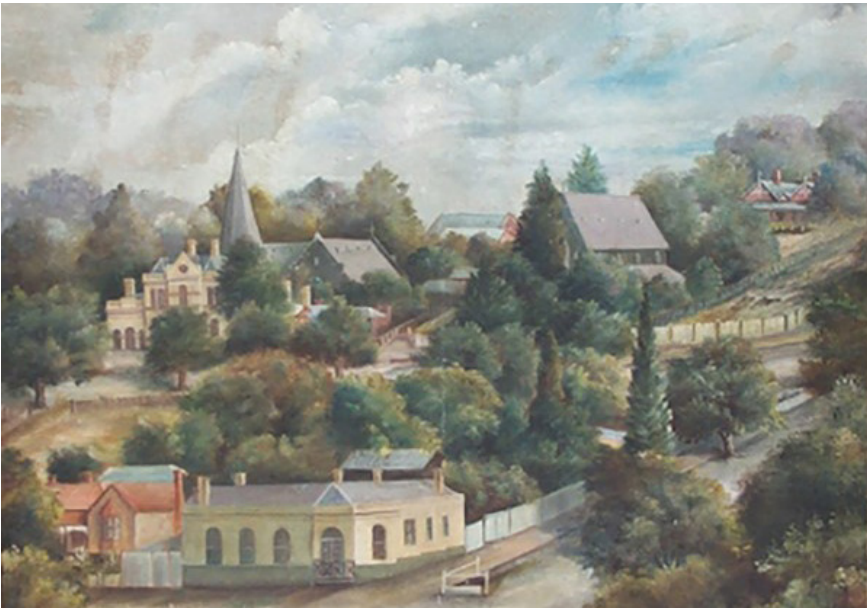
Corner of Fraser and Templeton Streets, circa 1920 by Richard Ford

However, it is the aforementioned Clunes Town Hall which was the recipient of some of the most substantial creations. They came about in the form of a detailed stage proscenium and a war memorial painting, both of which can still be viewed today in the large public meeting room.
A century ago town halls were one of the main spaces for regional dwellers. There people would gather to dance, listen to music and watch plays. And the proscenium backing the stage was as essential as chairs and lights. Generally they featured a painted backdrop, movable wings and a physical proscenium arch. The entire installation then served as the frame into which the audience observed a theatrical performance. By 1916 the time had come to replace the old proscenium and as a council foreman , Ford was uniquely placed to offer his skills in the creation of a new one.
The result was spectacular. The backdrop depicted a paved patio bracketed by neo-classical balustrades looking out over a sumptuous lake and dramatic mountains. Four rectangular wings around three metres high featured sturdy oak trees thick with foliage. On their reverse side were framed vignettes of subjects such as native flowers and swaggies by water holes. With the flick of a latch, the stage could go from a European theme to Australian theme in moments.
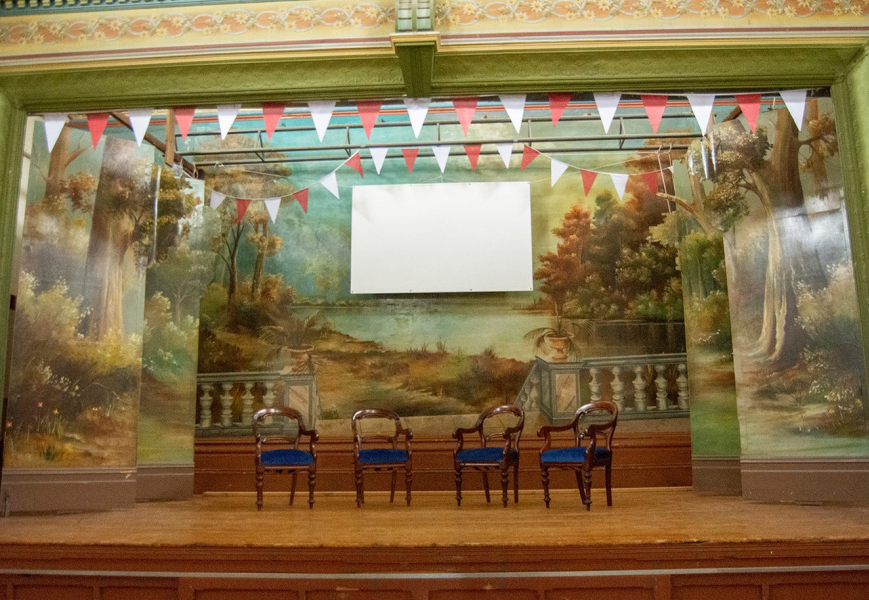
The proscenium in the main meeting room of the Clunes Town Hall and Courthouse.

Needless to say the council and town loved the final result and many spoke in “most eulogistic terms of the fine painting executed by Mr Ford,” as reported by the Clunes Guardian and Gazette. In response: “Ford said he could hardly express his feelings. He had done the work to the best of his ability and he was pleased to know that his efforts had been appreciated.”

Six years later a memorial was created in the same space featuring photos of soldiers and nurses who served in the Great War and Ford was able to contribute once again. “In the centre is the representation of a rising sun,” reports the Clunes Guardian and Gazette, “brilliantly and artistically painted by Mr Ford to whom much praise is due for the skill and care has has bestowed upon the whole work”.
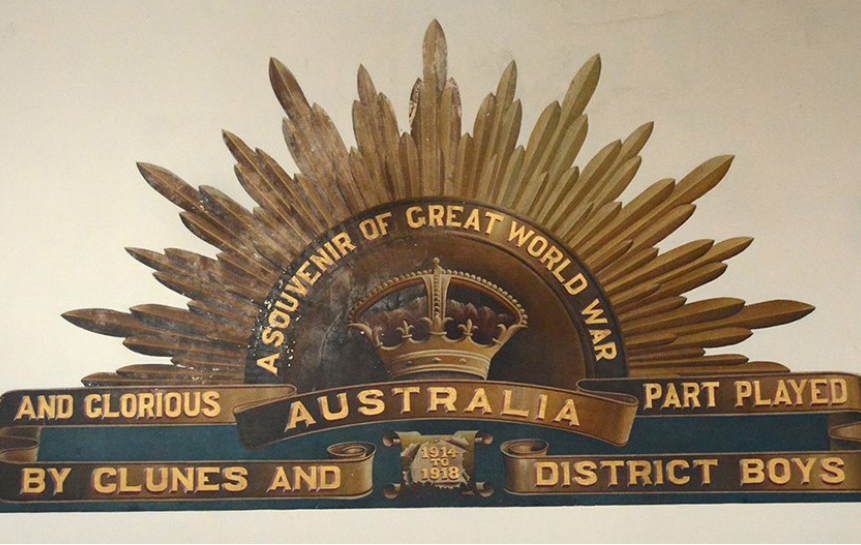
The rising sun war memorial designed by Richard Ford. Image Tony Sawrey.

A century later his works remain in good condition. And with the Town Hall refurbishment and restoration works now complete, a new generation of Clunes residents and visitors will have the chance to experience them again in their glory.
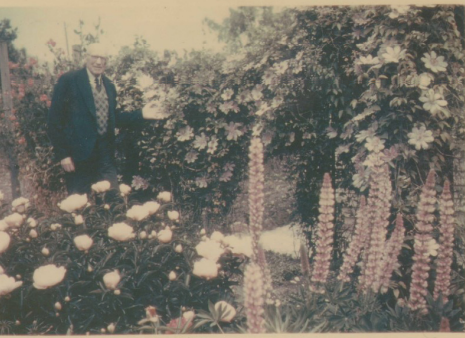
Richard Ford in his garden in 1941

Clunes Common long closed to the public

While not many people would realise it today, most towns in this region, indeed across Victoria, had areas set aside known as Town Commons.

Words by Anthony Sawrey, with permission of The Local

Research by James Curzon-Siggers

It was just one instance of the widespread colonial practice in the 19th century of reserving specific pieces of land for a variety of public uses.

By 1890 more than 6,000 square kilometres existed as officially designated common land. Unfortunately much of this land has been divided up, built upon and sold off over the years and there are very few intact examples to be found anywhere in the state. However Clunes is one of those rare exceptions.

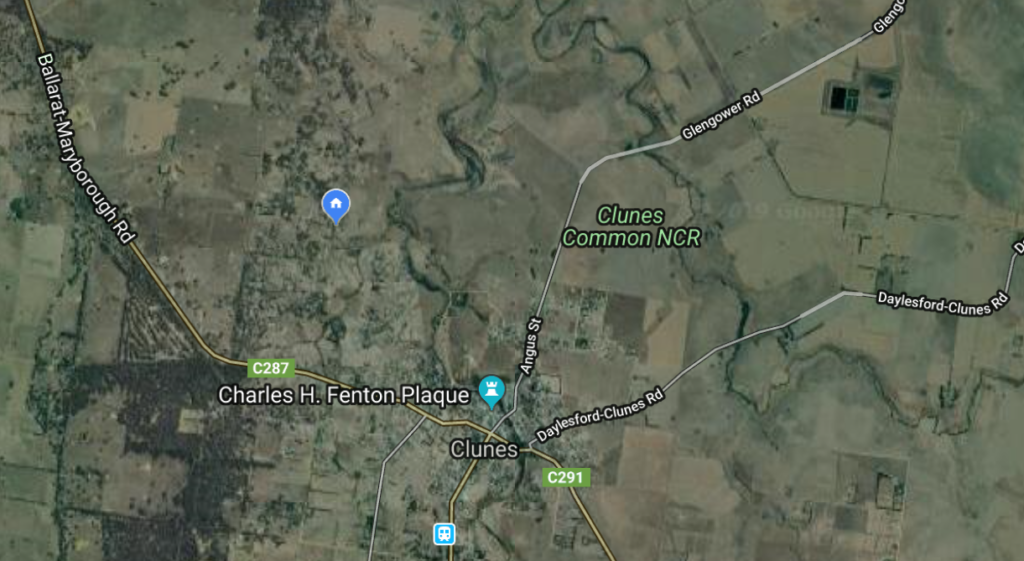
If you want to go and see it, the Clunes Town Common lies north of the present township, straddling Glengower Road. Bracketed by Birch Creek to the east and Creswick Creek to the west it covers about 216 hectares. Its boundaries remain as they were set when first proclaimed by the Victorian Parliament in 1861.

In those times, well before the advent of modern social welfare support, town commons were an essential part of the fabric of the surrounding community; as pointed out by researcher Ben Maddison in A Kind of Joy-Bell: Common Land, Wage Work and the Eight Hours Movement In Nineteenth Century NSW. “In 19th century New South Wales (and Victoria) the commons – denominated as either Temporary or Permanent…were set aside for travelling stock, pasturage, timber, water, indigenous communities, camping, recreation, ‘public purposes’ (schools, churches, cemeteries) and village, town and suburban expansion.”

In local terms this meant that “every inhabitant within the Municipal District of Clunes be entitled to departure six head of cattle or horses on the common”, and that a herdsman receiving a wage of 50 pounds per annum would be appointed to manage stock placed there. Later both Chinese and European residents could pay five shillings for a garden licence issued by the Department of Land and Survey (today’s DELWP) to “enter upon Crown Land not exceeding in area one acre for the purposes of garden and residence”.

However, unlike in the English tradition of productive common lands which had always been an insurance against hard times, common lands in the colonies were often little more than a resource to be exploited. The often became a locus of competition or conflicts over stocking rates and boundary maintenance and were frequently neglected with weeds, rabbits and mining activity contributing to their eventual decline.

The Clunes Common suffered from these issues and by 1918 the Ballarat Courier had a small news item titled: Clunes Common Recommended for Subdivision. But while the other town commons were carved up the Clunes Common remained largely intact and in regular use right up to 1960s. One of those people who remembers it well is John Overberg who settled in Clunes with his parents and five siblings from Holland in 1955.

“We had a house cow, as many people used to in those times, for milk and to make our own butter, cream and cottage cheese. The cow would stay at the house overnight but after milking in the morning you would just let it loose on the common and after school you would collect it and milk again. Sometimes you had to walk a couple of miles to find her. We also had about 16 goats there. The common was certainly an important asset to people like us to help make ends meet. It was also a great playground as we grew up.”

But by the turn of the 1970s the Clunes Common was little more than unused public land and was leased to a local farmer. It is now fully fenced and off-limits to the public. But few tears were shed at the time because society had moved on.

The old dependence on laborious activities such as maintaining a milking cow was hardly necessary when supermarkets could provide such produce cheaply and reliably. What’s more, with the emergence of the sort of social security net taken for granted today families no longer have to grow their own food or collect their own milk to survive, they can do it for fun.

There is also the fact regional councils no longer allow dairy cows to wander on the outskirts of towns nor permit mobs of goats to amble down suburban streets looking for blackberries to eat. The past is certainly another country.

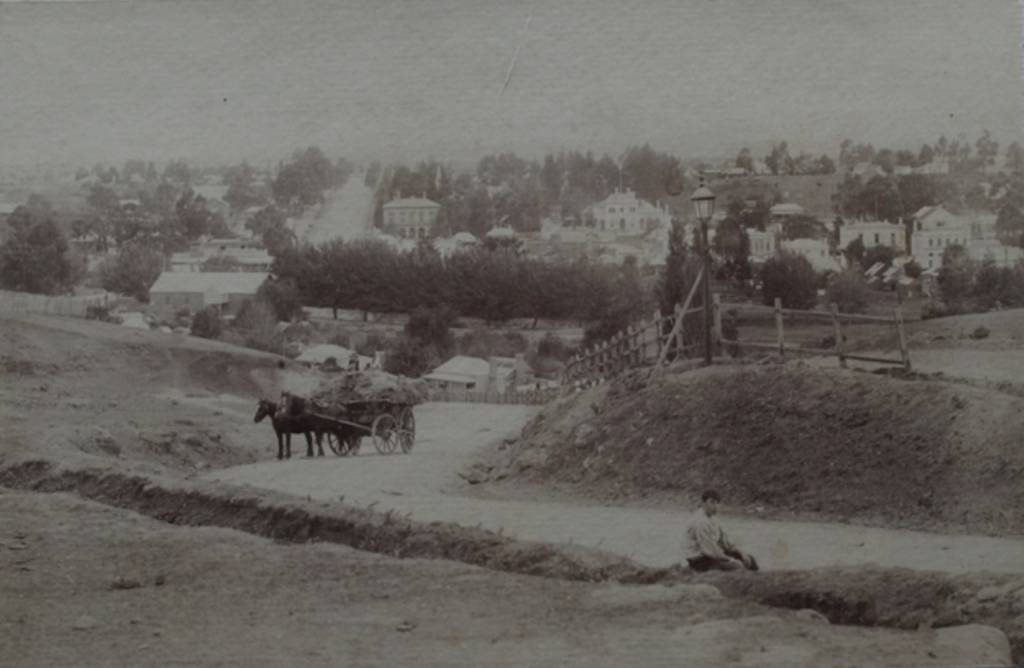
Heading up Angus Street towards the Common, 1900-1905
Current aerial view of the Common

” Wasn’t the Chinese a man and a brother?” : the Clunes 1873 Riot Exhibition

By James Curzon-Siggers, Clunes Museum President

The Clunes Museum and Ballarat’s Federation University are collaborating on a a major exhibition which will focus on that signature event in the history of our town – the industrial action and strike of late 1873 at the Lothair mine which culminated in the events of December 9, 1873, often categorized as an anti-Chinese race riot by many historians writing generalist histories. In-depth research reveals a different and more complex story. This was a major event in the history of the goldfields, in the development of Australian trade unionism and, according to some, the making of the White Australia policy. The exhibition will be held next year to coincide with the International Booktown Festival in May and runs from mid-April to the end of May. Professor Keir Reeves and the team at Federation University’s Australian History Dept. will guest curate the exhibition. Can you help? We will look at this iconic Clunes event and its myths from a range of perspectives and there will be a focus on the individuals involved such as Peter Lalor, a Lothair mine director; Robert Bryant, the mine manager; William Blanchard, 1st President of the Clunes Miners’ Association and Mayor as well as wives and women, the strikebreakers, the miners, the Clunes Marching Band, the police and Chinese living in Clunes, Creswick and Ballarat.

If you think you have any old photos or documents or mine plans or maps or letters or lithographs or information about individuals that may be relevant, we’d like to hear from you. Contact me on 0412853410 or through the Museum.

Clunes Museum Now On Facebook

The Museum is now on Facebook! Hit like on the Clunes Museum page and enjoy posts and photos about our town’s rich history from deep inside the Museum’s archives.

The Museum is now on Facebook! Hit like on the Clunes Museum page and enjoy posts and photos about our town’s rich history from deep inside the Museum’s archives: https://www.facebook.com/clunesmuseum/

Since the start of the year, the Museum has had a new website. It uses responsive software so you can easily view it on your smartphone. We’ll be adding new features and making improvements as we go along. Thanks to Wordsworth Communicating for doing such a great job.

We have also started using a new digital cataloguing program called Victorian Collections. This has an online facility so anyone can see what we have in our collection and in our archives, items not currently on display, as well as items from all other local history museums that use the same software: https://victoriancollections.net.au/organisations/clunes-museum?page=1-2&rnd=vu0#collection-records

At our next monthly meeting, we’ll be considering special projects for the next 12 months. These include a special exhibition to coincide with next year’s May Booktown Festival, an Oral History program and an Annual Clunes Museum Walking Tour. Volunteers always made
welcome. If you’re interested, our contact details are on the website.